Choosing an eSignature platform is a significant decision for any organization. The platform you select will handle sensitive contracts, employee records, customer agreements, and compliance-critical documents. But before you commit, there is one document that deserves your careful attention: the esignature vendor agreement itself. This contract defines what you are getting, what you are paying, how your data is handled, and what happens if something goes wrong.
Reviewing the esignature vendor agreement thoroughly before signing helps you avoid surprises later. Many organizations focus entirely on features and demo experiences during evaluation. They compare dashboards, test mobile signing, and check integration availability. But the fine print in the vendor agreement contains terms that directly affect your security posture, your budget, and your ability to switch providers down the line. Taking time to understand these terms upfront saves your legal and procurement teams from discovering unfavorable clauses after you have already invested time and resources in implementation.
What Compliance Guarantees Should the Vendor Agreement Include?
The vendor agreement should clearly state which compliance standards the platform meets and how those standards are maintained over time. This matters because your own regulatory obligations depend on your vendor’s ability to protect data according to industry-specific requirements.
Look for explicit commitments to HIPAA compliance with a signed Business Associate Agreement if you handle protected health information. The agreement should confirm SOC 2 Type II certification and explain how often audits are conducted. ISO 27001 certification demonstrates that the vendor follows international information security management standards. For financial services, PCI DSS certification is necessary if you process payment data through the platform.
The agreement should also address GDPR compliance for handling EU resident data, CCPA compliance for California residents, and eIDAS alignment for European digital transactions. If your organization operates in life sciences, 21 CFR Part 11 compliance for electronic records and signatures should be explicitly mentioned. Each of these certifications and frameworks should be documented in the agreement with clear renewal and audit schedules, not just mentioned in marketing materials.
A vendor that cannot commit to maintaining these standards in writing may not be suitable for regulated industries. The agreement should include provisions for what happens if a certification lapses or if the vendor fails a compliance audit.
How Does the Agreement Address Data Security and Encryption?
Data security terms in the vendor agreement tell you how your documents are protected at every stage. The agreement should specify the encryption standards used for data in transit and at rest. TLS 1.2 or TLS 1.3 encryption should protect documents while they travel between users and the platform servers. AES-256 encryption should secure files stored on the platform’s infrastructure.
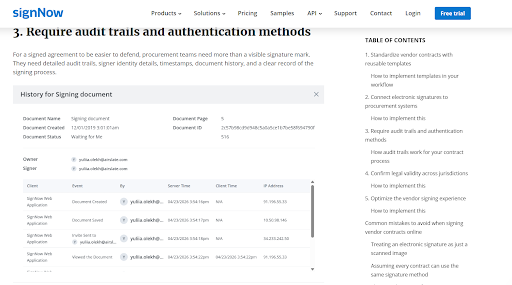
Authentication requirements should also be clear. The agreement should confirm that two-factor authentication is available and describe how signer identities are verified. Audit trail provisions should guarantee that every signature event is recorded with timestamps, IP addresses, and signer identifiers. These audit logs serve as critical evidence if a signer disputes their signature or if a regulator requests proof of compliance.
The agreement should address how long audit trails are retained and whether they can be exported for external review. Some vendors limit access to audit data or charge extra for detailed logs. Understanding these terms before signing prevents surprises when you need to produce evidence for a legal proceeding or regulatory audit.
What Pricing and Usage Terms Should You Watch For?
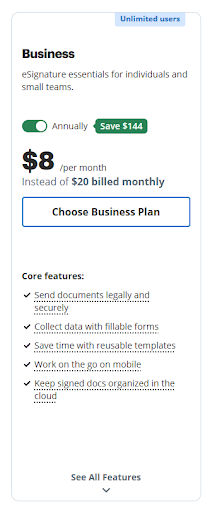
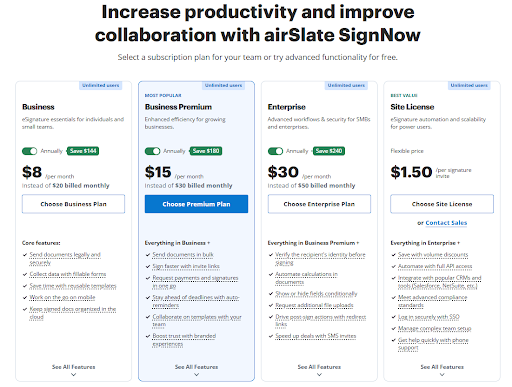
Pricing terms in eSignature vendor agreements vary widely, and the differences can cost your organization significantly over time. Look beyond the headline price per user and examine how the platform handles scaling, overages, and feature access.
Key terms to review include whether the plan charges per user or uses a different pricing model. Per-user pricing can become expensive as you onboard more team members. Some vendors also impose annual envelope caps, limiting how many documents each user can send per year. Exceeding these caps triggers overage fees that are often much higher than the base plan price. A plan with unlimited users and no envelope caps removes these scaling concerns entirely.
The agreement should also clarify what happens at renewal. Some vendors increase prices significantly after the first term. Others add fees for features that were included during the trial period, such as templates, API access, or integrations. Confirm that support levels, audit trail access, and template limits are locked in for the duration of the agreement.
Additionally, check whether the agreement requires a minimum commitment or allows month-to-month billing. Annual billing typically offers a lower per-user rate, but it also locks you in for twelve months. If you are evaluating multiple platforms, a shorter commitment period gives you flexibility to switch if the platform does not meet expectations.
How Does the Agreement Handle Data Ownership and Portability?
Your documents belong to you, and the vendor agreement should state this clearly. Look for language that confirms you retain full ownership of all documents, templates, and data stored on the platform. The vendor should have no claim to your content and should not use your documents for any purpose beyond providing the service.
Data portability is equally important. The agreement should guarantee that you can export your documents, audit trails, and account data in standard formats if you decide to leave the platform. Some vendors make data export difficult or charge fees for bulk downloads. Others limit the time window during which you can retrieve your data after canceling. These terms can make switching vendors expensive and time-consuming if they are not carefully reviewed upfront.
The agreement should also address data deletion upon contract termination. Confirm that the vendor will delete all copies of your data from their systems within a reasonable timeframe after your agreement ends. For organizations in regulated industries, this provision is essential for maintaining compliance with data protection requirements.
What Support and Uptime Commitments Are Included?
Vendor agreements vary significantly in their support commitments. Some platforms include 24/7 live support on all paid plans, while others charge extra for priority support or limit support hours based on your plan tier. The agreement should specify support availability, response times, and escalation procedures.
Uptime service-level agreements are another critical term. The agreement should guarantee a minimum uptime percentage, typically 99.9% or higher, with defined remedies if the vendor fails to meet this commitment. Credits or service adjustments for downtime protect your organization if the platform becomes unavailable during critical signing periods.
Review whether the agreement includes a dedicated account manager or customer success contact for your organization. Enterprise deployments often benefit from having a single point of contact who understands your workflow and compliance requirements. This is especially valuable for organizations rolling out eSignature across multiple departments or international locations.
How Does the Agreement Handle Contract Termination and Transition?
The termination terms in the vendor agreement determine how easily you can leave if the platform no longer meets your needs. Look for provisions that allow termination for convenience with reasonable notice, typically thirty to sixty days. Avoid agreements with long notice periods or steep early termination fees.
The agreement should also address what happens to your data and signed documents after termination. You should have a defined period to export all data before the vendor deletes it. Thirty to ninety days is standard. The vendor should assist with data migration to a new platform if needed, though this may be a paid service.
Finally, review whether the agreement auto-renews and what notice is required to prevent renewal. Many organizations get locked into another year of service simply because they missed a renewal notice window. Setting calendar reminders for these dates helps you avoid unintended commitments.
FAQ
What is the most important clause in an eSignature vendor agreement? The data ownership and portability clause is often the most critical. It determines whether you can leave the platform with your documents intact. Without clear portability terms, switching vendors can become expensive and time-consuming.
How often should compliance certifications be verified? Review compliance certifications annually or whenever the vendor undergoes a recertification audit. SOC 2 Type II reports are typically valid for twelve months. HIPAA BAA agreements should be reviewed whenever your data handling practices change.
Are envelope caps common in eSignature vendor agreements? Yes, many vendors impose annual envelope caps that limit how many documents each user can send per year. Exceeding these caps triggers overage fees. Some platforms like signNow offer no envelope caps on any paid plan, which removes this concern entirely.
What should I look for in the pricing terms? Check for per-user pricing, envelope caps, auto-renewal price increases, and fees for features that were free during the trial. Compare these terms across vendors to understand the total cost of ownership over multiple years.
Can I negotiate eSignature vendor agreement terms? Yes, especially for mid-market and enterprise deployments. Vendors are often willing to adjust pricing, add custom terms, or provide enhanced support commitments for larger accounts. Always ask before accepting the standard agreement.
How long does data remain accessible after canceling an eSignature account? Most vendors provide thirty to ninety days to export your data after cancellation. After this window, your documents and audit trails are typically deleted. Confirm this timeframe in the agreement before signing.